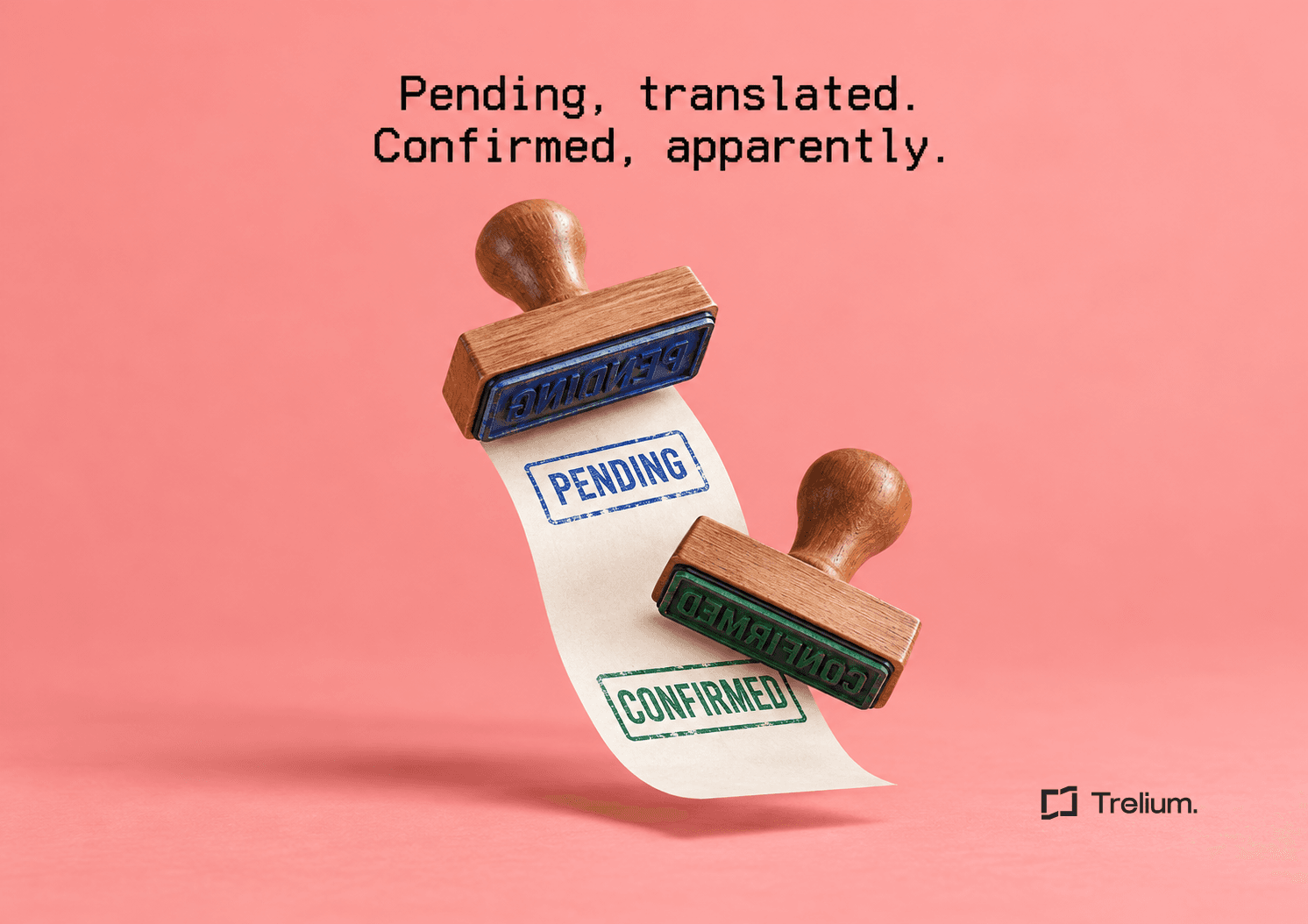
Inés leads customer service at Saltmarsh Drinkware, a made-up promo supplier. It is Wednesday at 4:50 p.m., and she is ten minutes from leaving when a reply arrives from a distributor in Quebec. It says, warmly and in French, that they are delighted production is confirmed and have told their client the bottles will ship next week.
Production is not confirmed. Inés knows this because she wrote the original message herself, in English, and it said production scheduling was pending. Somewhere between her draft and the customer's inbox, "pending" became "confirmed." The translated email was fluent and polite, and it was wrong in the one word that mattered.
She now has a distributor who has made a promise to their client, a production lead who has not scheduled anything, and a translated message nobody on her team can fully read. She also has, she notes, ten minutes.
The people and company here are made up, but the slip probably isn't. Fluent wording is easy to mistake for an approved message, especially at 4:50 on a Wednesday.
A reviewable multilingual customer-email workflow starts with approved order facts and a clear source-language message, then checks the translation against both. Protect ID numbers, quantities, prices, and dates; review conditional language and commercial commitments in the target language. If the necessary business or language review is missing, keep the email pending rather than treating fluent wording as approval.
For promo suppliers and distributors serving customers in multiple languages, this proposed review framework separates factual approval, translation, language review, and sending authority. It does not establish a translation tool's accuracy or the quality of an unreviewed language pair.
Prepare an approved fact packet
Before drafting, gather the exact order reference, product codes, quantities, currency, relevant dates, artwork version, and status. Link each fact to its source and record when time-sensitive information was checked.
Keep unresolved information out of the message as an assertion. If production has provided an estimated ship date but has not committed to it, preserve that distinction. If the customer asked for a discount, the agent should not treat the request as approved because it appears in the same thread as the order details.
Limit the source packet to information needed for this recipient and purpose. Internal margin, supplier disputes, and unrelated account notes should not travel into a customer email simply because they were available during research.
Inés pulls up the original thread. A fact packet, had anyone written one, would have said "production scheduling: pending, no date approved." It would have taken about a minute. The phone call she is about to make will take longer.
Draft the business meaning first
Create a short source-language draft that states the purpose, facts, requested action, and any approved commitment. Have the responsible person resolve commercial decisions before translation when possible.
Worked example: This example is made up and remains in English; it is not a validated foreign-language sample. It follows one proof approval from the source message to the send decision.
Input
PO 2074 needs approval of proof version 2. The approved source message says production scheduling remains pending and asks whether logo placement needs to change. No reply deadline or production start date has been approved.
Decision
The translation must preserve the pending state, the exact proof version, and the request for approval. "Production begins after your reply" would introduce a commitment not present in the source.
Action
Prepare the translated draft alongside the approved source, a glossary, and a comparison of PO number, proof version, dates, and quantities. Ask the language reviewer to check the approval dependency and the business owner to check commitments.
Stop
Do not send if the translation changes pending to confirmed, adds a deadline, or lacks required language review. Correct and re-review the changed meaning before sending under the approved communication policy.
Writing the source draft clearly helps the reviewer compare meanings. Avoid idioms, ambiguous pronouns, and compressed phrases such as "good to go" when the phrase could mean either artwork approval or permission to release production.
Maintain a glossary for the work you actually do
Build a reviewed glossary for common terms such as proof, setup charge, imprint area, in-hands date, embroidery, and partial shipment. Include the language pair, intended meaning, approved equivalent, and terms that should remain unchanged.
Product codes, customer PO numbers, brand names, and artwork version labels should generally be left untranslated. Where a customer uses its own approved terminology, record that preference with its scope rather than applying it to every account.
Check the selected service's exact glossary behavior. Microsoft's Document Translation documentation supports pairs of terms, one in the original language and one in the translation, and preserving a name by using the same text on both sides. It treats capital letters as significant when matching terms inside a sentence, but not when matching complete sentences. Those documented behaviors apply to that service; test the actual email workflow and language pair rather than assuming a glossary guarantees meaning. Microsoft glossary guidance.
The glossary is a review aid
The glossary is a review aid. It does not settle the surrounding sentence or remove the need for a competent speaker when meaning is consequential.
Lock the details that cannot drift
Compare the draft and translation for ID numbers, quantities, prices, currency, dates, units, and links. Use explicit dates and time zones where they matter. A numeric date that is obvious to one region can be ambiguous in another.
Do not convert currencies or measurement units as an incidental part of translating. If a conversion is useful, it needs an approved method and a clear label. Preserve the commercial unit as well: a price per piece and a price per case cannot be interchanged.
Review negation and conditional language carefully. "Production cannot begin until approval" contains a dependency. Omitting one word changes the operational instruction. The same applies to estimated versus confirmed dates, options versus commitments, and requested versus accepted changes.
This is the part Inés would like printed and taped to every monitor on her team. One word moved from pending to confirmed, and a ship date came along with it.
Use review levels suited to the message
Routine acknowledgment
- Can follow an approved template
- Narrowly defined sending policy
Consequential message
- New price commitment
- Delivery exception
- Complaint response
- Cancellation
- Change to agreed terms
- Goes to the accountable business owner and an appropriate language reviewer
Show reviewers the source draft, translated draft, comparison of the locked details, and unresolved questions together. Asking a bilingual reviewer to inspect an isolated translation forces them to reconstruct the original intent.
Back-translation is not enough
Back-translation, which means translating the message back into the original language, can reveal possible changes in meaning, but it is another AI-generated output and should not be the sole acceptance test. For consequential messages, a competent speaker needs to evaluate the translated meaning directly. If that review is unavailable, keep the message pending or use an approved alternative communication process.
Save the version that was actually sent
Record the approved source, approved translation, glossary version, reviewers, recipient, and send time. If someone edits the commercial substance after review, send it through the relevant checks again. A changed price or date can invalidate an otherwise sound translation approval.
Keep the original incoming customer message alongside any translation used internally. When a customer replies with a correction, the team should be able to compare the actual words, not only successive summaries of them.
Evaluate meaning and resolution
Test routine inquiries, artwork approvals, late shipments, price changes, and regional date formats with qualified reviewers. Track fact changes, terminology corrections, unintended commitments, customer clarification requests, and time to a usable approved reply.
What earns trust
A multilingual workflow earns trust when customers receive clear messages and employees can explain how each commitment was authorized. The agent can help prepare and compare drafts; the business remains responsible for the facts and promises those drafts carry.
Thursday morning at Saltmarsh
Inés calls the distributor on Thursday morning with a French-speaking colleague from the warehouse on the line. Together they explain that scheduling is still pending and commit only to what production has actually approved: a firm date by Friday. The distributor is gracious about it. Their client is less gracious, but that conversation belongs to someone else.
Afterward, Inés starts a glossary. The first entry is "pending." The second is "confirmed." She asks her colleague to review both, and adds one line to the team's process: a translated message that carries a commitment waits until someone who reads the language has checked it against the source. It is not a sophisticated system yet. It does keep one word from turning into a promise.

Ritanshu Dokania
Co-Founder
Get started
Ready to see Trelium in action?
Schedule a 30-minute conversation about the workflow you want Trelium to handle.
Book a Demo→