SanMar and S&S Activewear have already done the hard part: making product, pricing, inventory, order, invoice, and shipping information electronically accessible. The bottleneck is turning that supplier data into a workflow your team can use every day.
“It's 2026; you do not need to read API docs anymore. I recommend reading 101 Ways to Touch Grass.” - Ritanshu Dokania, Co-Founder, Trelium
Someone still has to request credentials, read the documentation, map fields, connect the supplier APIs to another system, test edge cases, and maintain the integration. That takes enough technical bandwidth that the project often never happens, while salespeople keep checking supplier websites manually, operations teams keep copying SKUs between systems, and quotes keep using information that can become outdated before the customer replies.
Trelium is integrated with SanMar and S&S Activewear so teams can move supplier data between the software they already use without becoming integration engineers first.
SanMar and S&S provide excellent data infrastructure. Trelium turns that infrastructure into a working business process.
Key Takeaways
- SanMar and S&S already provide strong electronic access to product, inventory, pricing, order, invoice, and shipping information.
- The main bottleneck is building and maintaining the connection between supplier data and the rest of the business.
- Manual lookups and duplicate entry create stale quotes, mismatched SKUs, pricing errors, and inconsistent records.
- Trelium connects SanMar and S&S to email, order-management systems, ERPs, CRMs, accounting tools, and other software through reusable AI-agent workflows.
What Is the Easiest Way to Integrate With SanMar and S&S APIs?
The easiest approach is to make the supplier API one step inside a complete business workflow instead of treating the API connection as the entire project. A traditional integration usually starts with credentials, authentication, endpoints, response formats, field mapping, build work, error handling, and long-term maintenance. None of that is impossible, but it requires technical bandwidth that most operations teams do not have.
- Describe what you want automated in plain English.
- Connect the relevant supplier and business accounts.
- Answer questions about pricing, approvals, exceptions, and routing rules.
- Launch an agent that runs the process repeatedly.
Example request
“When a quote request arrives by email, extract the requested products, check SanMar and S&S for current inventory and pricing, add our decoration and margin rules, create the quote in our order-management system, and send it to the salesperson for approval.”
Workflow outcome
“The operations person defines how the business process should work. Trelium handles how the systems communicate underneath it.”
What Data Can SanMar and S&S Make Available?
SanMar and S&S make extensive supplier information electronically available, including product details, inventory, pricing, orders, invoices, and shipping information. SanMar Electronic Integration offerings include product inventory availability, order entry, invoices, and a direct connection with product, invoicing, and shipping data. The SanMar Data Library can provide SKU, style, color, size, product images, price, weight, and inventory information.
S&S describes its REST API as an option for product data, inventory, pricing, order placement, instant order confirmation, historical orders, order status, invoices, and tracking.
| Source | Useful Data | Workflow Value |
|---|---|---|
| SanMar | Product information, inventory, order entry, invoices, shipping data, images, weights, and pricing files. | Quote with live availability, estimate shipping, route orders, and keep purchasing records aligned. |
| S&S Activewear | Product data, inventory, pricing, order placement, confirmations, order status, invoices, and tracking. | Compare options, place supplier orders, monitor status, and update customers without manual portal checks. |
Why Does Integrating With SanMar and S&S Still Take So Much Bandwidth?
Integrating an API is not the same as automating a business process. An API can provide an inventory quantity, but it does not automatically know which supplier your company prefers, which warehouse should be used, which margin should be applied, whether the delivery date is still achievable, how decoration should be priced, where the quote should be created, who should approve a substitute item, or what should happen when information is missing.
Those decisions live inside the company. Someone has to translate them into workflow logic and connect that logic to every relevant system. In a screen-printing community discussion, operators describe the same gap: supplier data exists, but custom scripts, middleware, scheduled uploads, and one-off integrations still take time to implement and keep synchronized.
How Does Manual Entry Create Inconsistent Supplier Data?
Manual entry creates inconsistency because live supplier information gets copied into several systems that stop updating together. A salesperson might check S&S inventory, copy quantities into a spreadsheet, check SanMar pricing, paste a cost into the CRM, add decoration and shipping manually, and send the quote. Four hours later, the customer changes the quantity or color, and the team has to decide which copied number is still current.
Wholesale apparel makes this especially difficult because one style can contain dozens of color and size combinations. Product data, pricing, inventory, variant mapping, warehouse availability, and order routing all need to remain connected, but manual work creates disconnected versions of the truth.
How Does Trelium Connect SanMar and S&S to the Rest of Your Software?
Trelium acts as an agent layer between supplier data and the software where the rest of the business process happens. It does not replace SanMar, S&S, your ERP, your CRM, your order-management system, or your accounting platform. It connects the work happening between them.
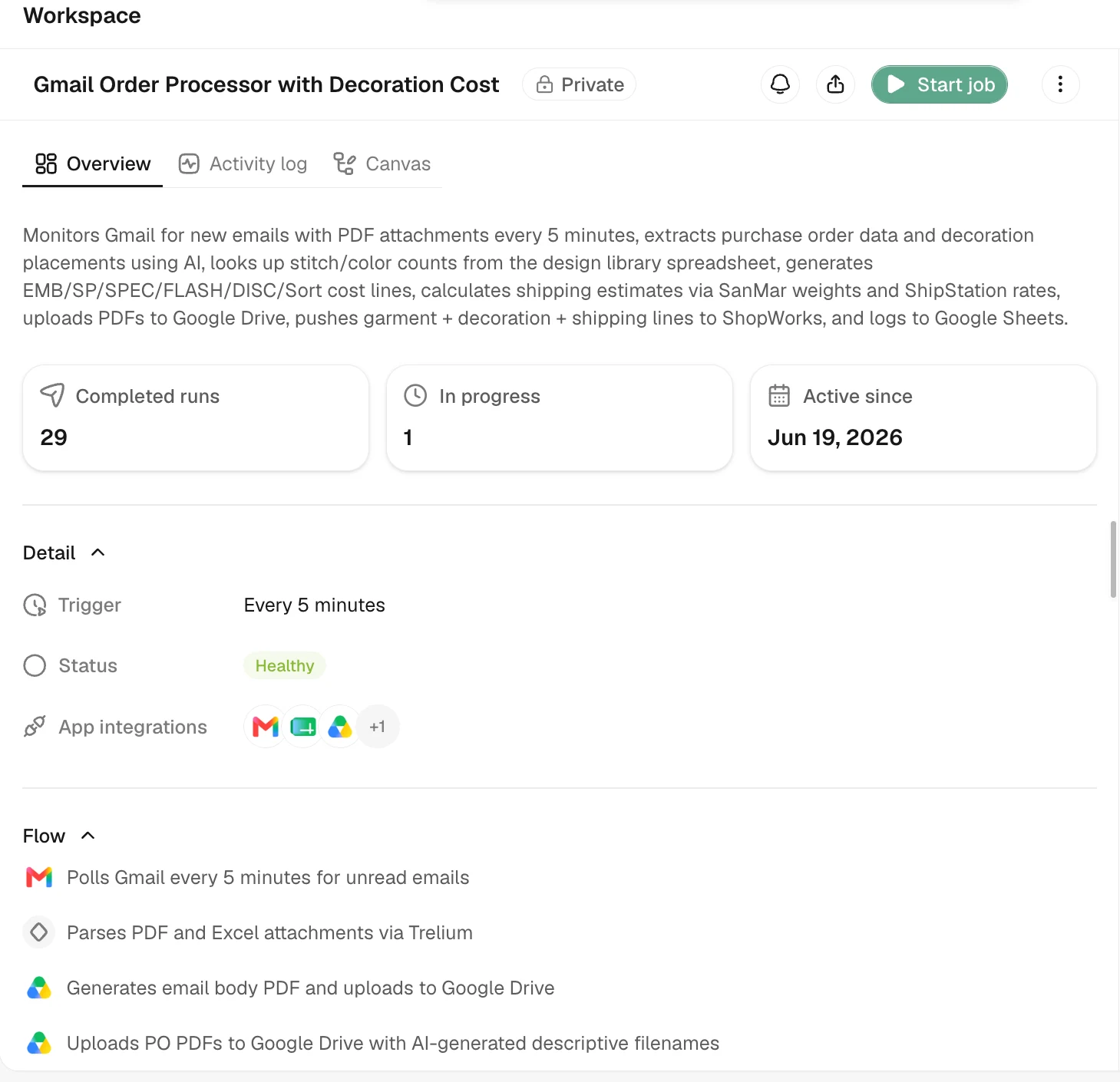
This example workflow monitors order emails, reads PDF and Excel attachments, extracts purchase-order and decoration details, uses SanMar data for product weights and shipping estimates, creates the right cost lines, uploads supporting documents, updates ShopWorks, and logs the outcome in Google Sheets. Trelium adapts this pattern for each customer based on their inbox, supplier accounts, pricing rules, approval paths, and order-management system.
The result is not a standalone API call. It is a supplier-aware workflow that moves a real order forward across the tools the team already uses.
What Are Some Ways Trelium Makes SanMar and S&S Integration Easier?
SanMar and S&S APIs are useful because they expose the live supplier facts that teams need: product data, variants, inventory, pricing, order status, tracking, invoices, weights, and shipping context. Trelium adds the business value by pulling those facts into the exact moment where work is happening and using them to complete quoting, purchasing, substitutions, tracking, invoice review, and customer communication.
Generate a Live Quote From an Email
The SanMar and S&S APIs are valuable at the quote stage because they can provide current product, variant, inventory, pricing, and warehouse information. A customer might ask for 250 black polos with left-chest embroidery before a specific date, but the salesperson still needs to know whether the right sizes are available, which supplier can fulfill them, and whether the margin still works after decoration and shipping.
Trelium turns that API access into a finished quoting workflow. It reads the email, extracts the requested products, checks SanMar and S&S for current pricing and inventory, applies margin and decoration rules, estimates shipping, creates the quote in the right system, and routes it for approval. If the customer changes the quantity tomorrow, the agent checks the supplier data again instead of relying on yesterday's spreadsheet.
Create Supplier Orders Automatically
The SanMar and S&S APIs are valuable after quote approval because the supplier order has to use the right SKU, color, size, quantity, warehouse, shipping method, and account-specific purchasing rules. If that information is copied by hand from the customer order into a supplier portal or purchase-order screen, small mistakes become backorders, substitutions, and status-chasing later.
Trelium turns supplier-order API access into a validated purchasing workflow. The agent confirms line items against current supplier data, applies supplier-selection rules based on inventory, price, warehouse, delivery date, or preferred-supplier agreements, creates the supplier order, captures confirmation, and updates the order-management system.
Check Inventory and Recommend Alternatives
The SanMar and S&S APIs are valuable when the original product is unavailable because the answer is rarely just yes or no. The team needs to know whether another warehouse has stock, whether the other supplier has the same or comparable style, whether the substitute preserves margin, and whether the delivery date still works.
Trelium turns inventory API responses into a usable recommendation. It compares alternate warehouses, comparable styles, customer-specific pricing, expected shipping time, and minimum margin against your business rules, then presents the best available option to a salesperson or purchasing manager instead of dumping raw inventory numbers into another tab.
Keep Order Status and Tracking Synchronized
The SanMar and S&S APIs are valuable after the order is placed because supplier status and tracking are the facts customers keep asking for. Without automation, someone has to check portals, match supplier references back to internal orders, update the order-management system, and write the customer response.
Trelium turns status and tracking API access into a synchronized customer-service workflow. It retrieves supplier order and shipment information, matches it to the internal order, updates the systems where employees expect to see it, and prepares the customer response. If something is delayed or inconsistent, the agent escalates it to a person instead of silently guessing.
Match Supplier Invoices Against Purchase Orders
The SanMar and S&S APIs are valuable in invoice review because supplier invoice data has to line up with what was ordered, what shipped, and what the business expected to pay. Finance does not need another export; it needs to know which invoices match and which lines need review.
Trelium turns invoice API access into exception-based review. It compares supplier invoices against the original purchase order and flags only discrepancies that need human attention: supplier SKU, quantity ordered, quantity invoiced, expected unit cost, actual unit cost, freight charges, missing items, substitutions, and total variance. Most invoices match; software should handle those rows while humans review the exceptions.
Do I Need to Read the SanMar and S&S API Documentation?
No, not if you are using Trelium. The SanMar and S&S API documentation is useful for developers building integrations from scratch, but your operations team should not have to study endpoints, authentication, payloads, and error states just to automate a quote, order, status update, or invoice review. Trelium asks the business questions your team already knows how to answer and handles the integration work behind the workflow.
- What starts the workflow?
- Which information should be retrieved?
- Which pricing rules should be applied?
- What counts as an exception?
- Who should approve risky actions?
- Which systems need to be updated?
- What should happen next?
Frequently Asked Questions
Does Trelium Replace the SanMar or S&S Activewear API?
No. Trelium does not replace the SanMar or S&S Activewear APIs. Trelium uses supplier data from those systems and connects it to the rest of the workflow across email, order management, ERP, CRM, accounting, and other business software.
Can Trelium Use SanMar and S&S in the Same Workflow?
Yes. A Trelium agent can retrieve data from both suppliers and apply your own rules to decide which product, warehouse, or supplier should be used.
Does Trelium Replace Our Order-Management System or ERP?
No. Trelium works across the software you already use. It reads inputs, retrieves the required information, applies workflow rules, updates the correct system, and escalates exceptions.
Can Trelium Use Our Customer-Specific Pricing Rules?
Yes, when the connected supplier account and business systems make the necessary information available. Trelium can apply customer-specific margins, pricing formulas, preferred-supplier rules, and approval requirements inside the workflow.
Useful SanMar and S&S Integration Resources
Resources
What Is the Bottom Line?
SanMar and S&S Activewear have already built strong systems for making supplier data accessible. The missing piece is often the last mile: getting product data into the quote, the approved quote into purchasing, supplier status into the order-management system, tracking into the customer conversation, and invoice information into accounting.
Trelium connects those steps without requiring every distributor, decorator, or print shop to build and maintain its own integration infrastructure.
SanMar and S&S provide the data. Your existing software runs the business. Trelium connects the work happening between them.

Chirag Gupta
Member of GTM Staff
Get started
Ready to see Trelium in action?
Schedule a 30-minute conversation about the workflow you want Trelium to handle.
Book a Demo→