
Key Takeaways
- Claude Cowork is best suited to individual research, analysis, documents, and ad hoc multi-step AI tasks.
- Trelium is designed for persistent promotional products workflows that run across email, ERP, OMS, CRM, accounting, supplier portals, and other business systems.
- Trelium combines AI reasoning with deterministic execution, event triggers, human approvals, workflow logs, exception routing, and organization-wide sharing.
- The better choice depends on whether you want an AI assistant for one person or operational AI agents that keep business processes running across a company.
Claude Cowork is one of the clearest examples yet of where AI work is heading. It can work across files, use connected applications, navigate websites, perform multi-step tasks, and run recurring jobs. For an individual who wants an AI assistant capable of doing more than answering questions, Cowork is compelling.
This Claude Cowork vs. Trelium comparison focuses on that difference: helping one employee complete a task versus deploying AI agents that run operational workflows across an entire promotional products company. Distributors, suppliers, decorators, and print shops have repetitive work happening continuously across inboxes, ERP and order management systems, accounting software, CRMs, supplier portals, spreadsheets, and internal applications. That is the problem Trelium is designed to solve.
Cowork helps an individual get more work done. Trelium helps a company automate how work gets done.
Claude Cowork vs. Trelium: What Are the Main Differences?
Claude Cowork is best suited to individual, ad hoc AI work, while Trelium is designed for persistent operational workflows that run across a promotional products company.
Claude Cowork
- Best for individual knowledge work, research, analysis, documents, and ad hoc multi-step tasks.
- Runs agentic sessions with files, connected tools, browser access, plugins, and scheduled tasks.
- Useful when a person wants to delegate a task and stay close to the work.
- Usage and setup are centered around the individual Claude workspace.
Trelium
- Best for company-wide operational workflows in promotional products and print operations.
- Designed for persistent agents triggered by real business events across email, ERP, OMS, CRM, accounting, and supplier systems.
- Uses AI for judgment and deterministic software for repeatable execution.
- Shared credit pools, workflow logs, approvals, exceptions, review rules, and shareable workflows are built for operations teams.
If you need a personal AI coworker to research, organize, draft, analyze, or complete one-off tasks, Cowork is strong. If you need AI agents for promotional products operations - purchase order creation, order status, invoice matching, supplier follow-ups, artwork routing, CRM updates, and customer communication - Trelium is the better fit.
What Happened When We Gave Claude Cowork and Trelium the Same Workflow?
Trelium treated the request as a persistent operational workflow, while Claude Cowork approached it as an agentic task the user could configure and repeat.
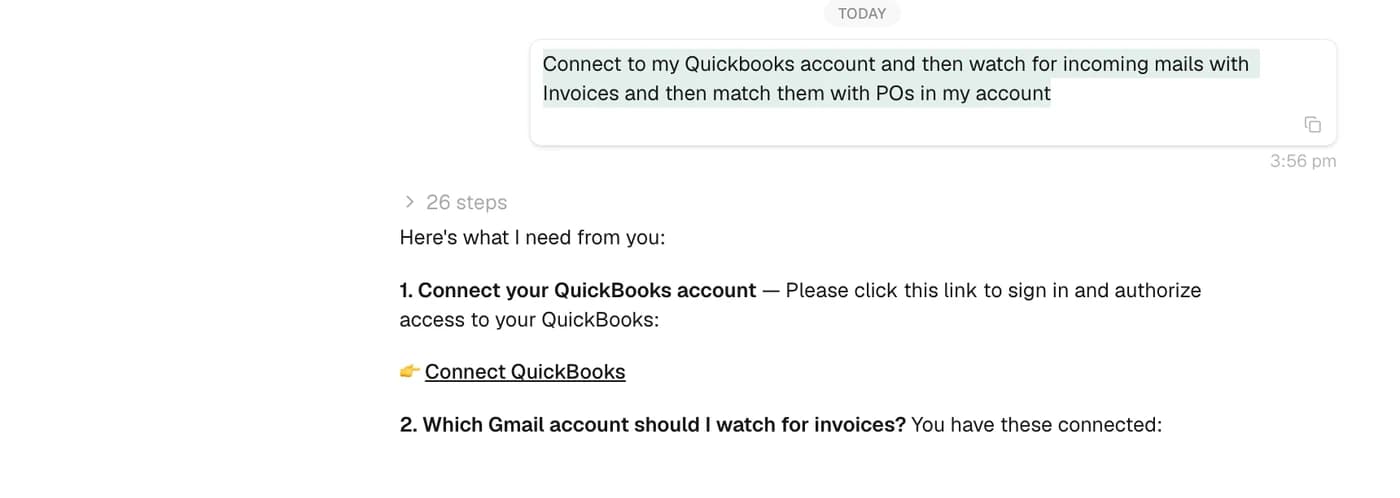
We tested a simple operational request that shows the difference: connect to QuickBooks, watch for incoming supplier invoices, and match those invoices against purchase orders.
Test workflow
“Connect to my QuickBooks account and then watch for incoming mails with invoices and match them with POs in my account.”
Operational question
“Is the system helping one person do the task, or is it creating a workflow that can keep running for the business?”
Trelium treated the request as an operational workflow. It identified the applications that needed to be connected, asked which inbox should be monitored, and began collecting the business rules required to automate invoice matching. The end goal was not simply to perform one invoice match. It was to create an agent that could continue performing the process whenever new invoices arrived.
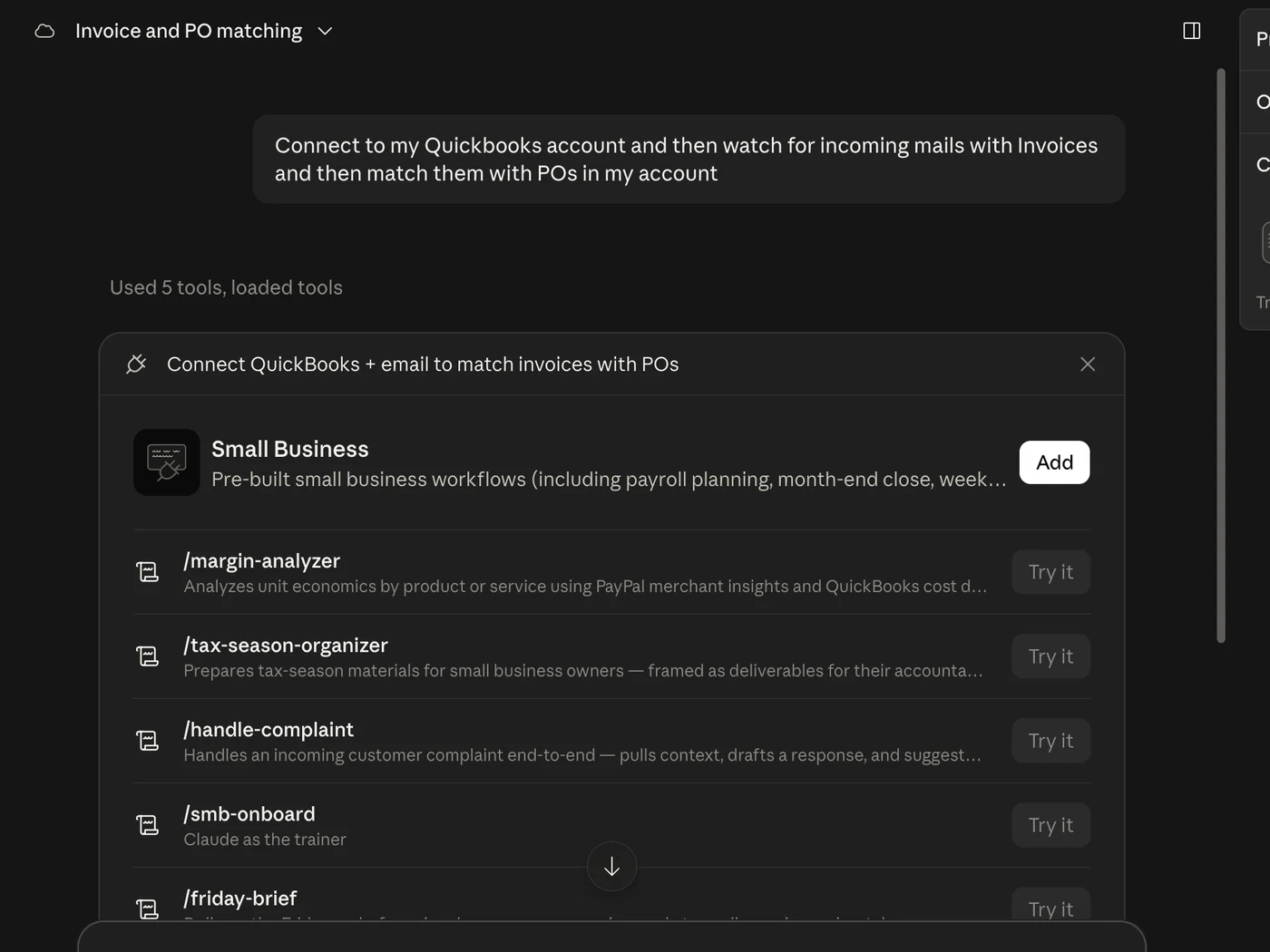
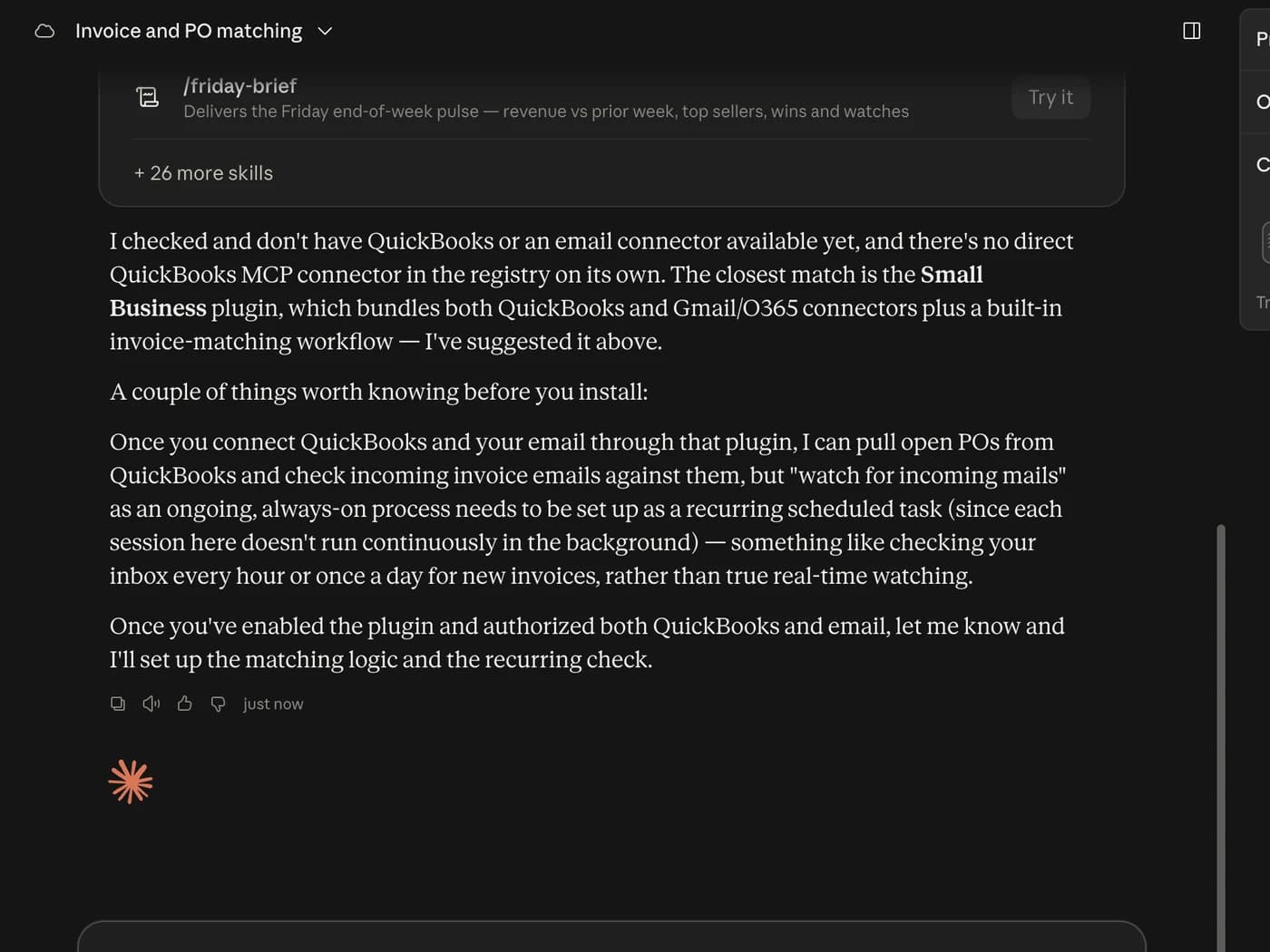
Cowork approached the same request as an agentic task. It searched for the relevant QuickBooks and email capabilities, suggested a plugin, and explained how the workflow could be run repeatedly. That is useful, but it also shows the extra work a user has to do: find the right plugin, understand what it includes, authorize the right tools, and decide how to make the task repeat. With Trelium, the integration work is part of the product experience. The common integrations are already set up, and when a company needs a custom integration for its ERP, supplier portal, accounting flow, or internal system, Trelium builds that into the workflow.
How Do Claude Cowork and Trelium Handle Event-Driven Workflows?
Trelium is designed to react to business events and keep workflows running continuously, while the Cowork workflow we tested framed inbox monitoring as a recurring scheduled check.
In our test, Cowork described incoming email monitoring as a recurring scheduled task. Checking an inbox every hour can be useful, but it is a different automation model from reacting when a business event happens.
That distinction appears everywhere in promotional products. A customer PO arrives. A supplier misses a promised date. A proof waits too long for approval. An order enters a delayed status. These are business events, not just tasks someone occasionally asks an assistant to perform.
Trelium is built around those events. Agents can run when a new email arrives, when a record changes, when a supplier update is missing, when a workflow crosses a threshold, or when a human approval is required. The workflow continues even when nobody is actively chatting with an AI assistant.
How Do Claude Cowork and Trelium Handle Integrations?
Claude Cowork gives users connectors, plugins, browser capabilities, and application integrations, while Trelium treats integrations and custom system access as part of the operational workflow implementation.
Promotional products businesses rarely operate inside one clean software stack. An order might begin in Gmail or Outlook, move into ShopWorks, Printavo, Syncore, NetSuite, YoPrint, ShopVOX, or another ERP or OMS, involve QuickBooks for accounting, require information from a supplier portal, and generate updates in a CRM or internal task system.
This is where the Claude Cowork vs. Trelium difference becomes most important. Cowork has made real progress with connectors, plugins, browser capabilities, and application integrations, so Claude can increasingly work across external systems. But the user still has to think in terms of what connector exists, what plugin should be installed, what permissions are needed, and whether the required system is reachable from the Claude workspace. Anthropic describes Cowork as agentic work for research, analysis, document creation, and other multi-step tasks, and its help center notes that Cowork sessions run in the cloud in beta.
Trelium treats integrations as core infrastructure rather than an accessory to the AI experience. Trelium already has the operational integrations set up for common systems across email, CRMs, ERPs, order management systems, accounting platforms, databases, supplier portals, and internal applications. When a company uses a niche system, a legacy tool, a supplier website, or a workflow-specific internal app, Trelium can build the custom integration for that workflow instead of asking a non-technical user to figure it out.
Main integration difference
With Claude Cowork, the user often has to discover and configure the right connector or plugin. With Trelium, integrations are part of the implementation: use the integrations already set up, add browser automation where needed, and build custom integrations for the customer's actual stack.
| Operational need | Why it matters | Trelium approach |
|---|---|---|
| Email and attachments | POs, invoices, proofs, status requests, and supplier updates often arrive in messy formats. | Read, classify, extract, route, and trigger workflows from incoming messages. |
| ERP and order systems | The source of truth may be ShopWorks, Syncore, Printavo, YoPrint, NetSuite, or an internal system. | Use existing Trelium integrations where available and build custom API or browser integrations when the workflow requires them. |
| Accounting | Invoice matching depends on POs, vendor records, totals, freight, tax, and variance rules. | Connect accounting workflows to approval rules, matching logic, and exception queues. |
| Supplier portals | Many suppliers still expose status, invoices, tracking, and proofs through web portals. | Add browser automation for supplier websites so the workflow can still complete without a clean API. |
How Does Trelium Use AI Differently From Claude Cowork?
Trelium uses AI when a workflow requires interpretation or judgment and deterministic software for predictable execution steps such as validations, lookups, updates, routing, and logging.
Large language models are excellent when a task requires understanding. They can interpret an unusual purchase order, extract information from a messy invoice, classify an exception, or reason about what should happen next.
But many operational steps do not require an AI model. Looking up PO 4821, comparing two known totals, checking whether a required field is present, updating a record through an API, or moving a file after approval should be deterministic.
Trelium workflow architecture
AI judgment
Used for interpretation, extraction, classification, exception reasoning, and deciding what information is missing.
Deterministic execution
Used for validations, lookups, updates, routing, logging, API calls, and repeatable business rules.
Human review
Used where risk, policy, ambiguity, or customer impact requires a person to approve the next step.
Trelium uses AI for judgment and software for execution.
For companies processing high volumes of orders, invoices, customer requests, or supplier communications, this architecture matters. It makes workflows more predictable, easier to audit, and more efficient to run than asking a model to rethink every repeatable step from scratch.
How Do Claude Cowork and Trelium Compare on Cost?
Claude Cowork usage is centered on individual Claude workspaces, while Trelium uses shared company-level workflow capacity so one deployed agent can support an entire team.
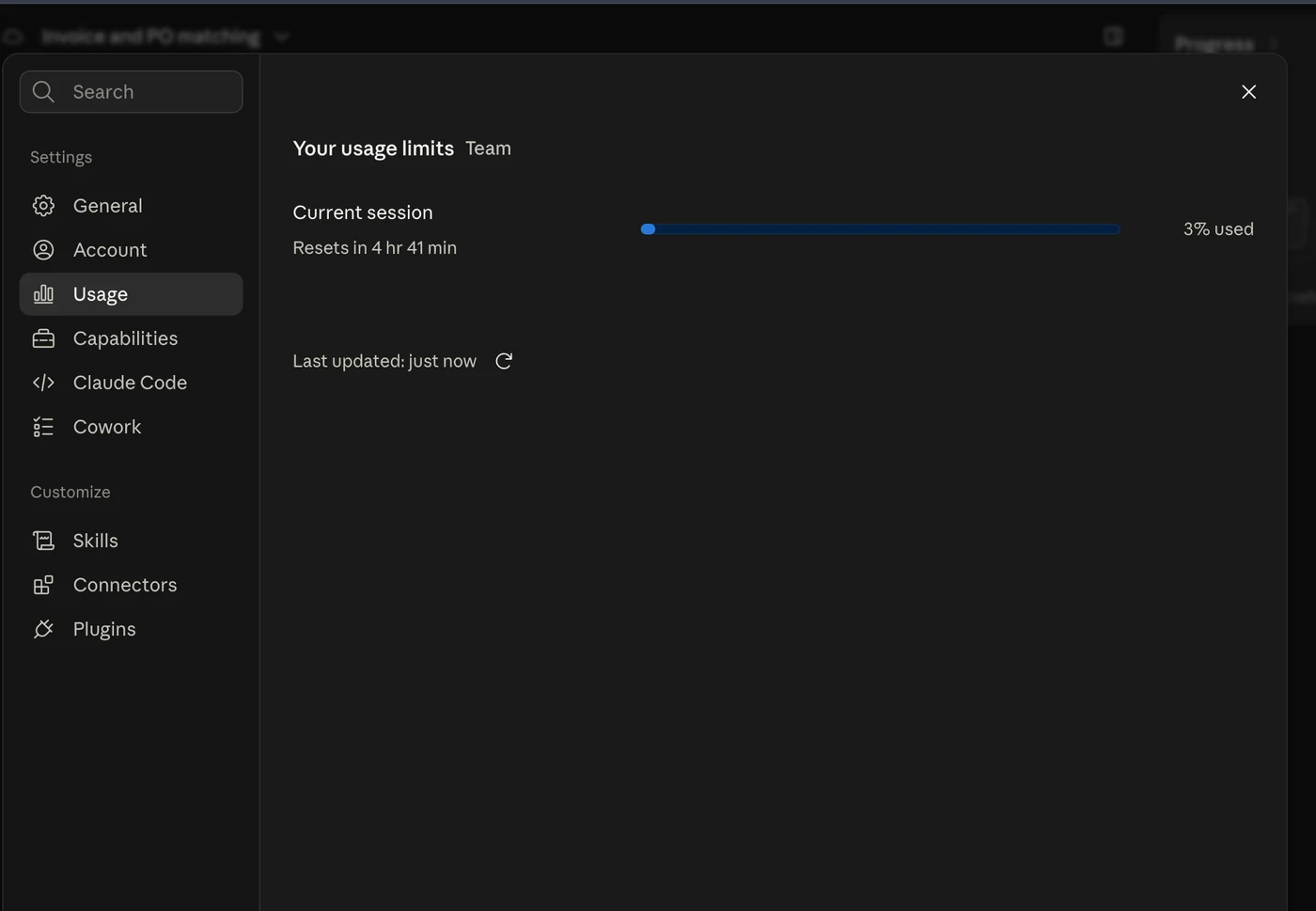
Cowork is centered on individual Claude usage. That can make sense when one person is experimenting, but it becomes less efficient when a whole company wants AI to run repeated operational work. Each employee has their own workspace, their own usage limits, and their own agentic sessions.
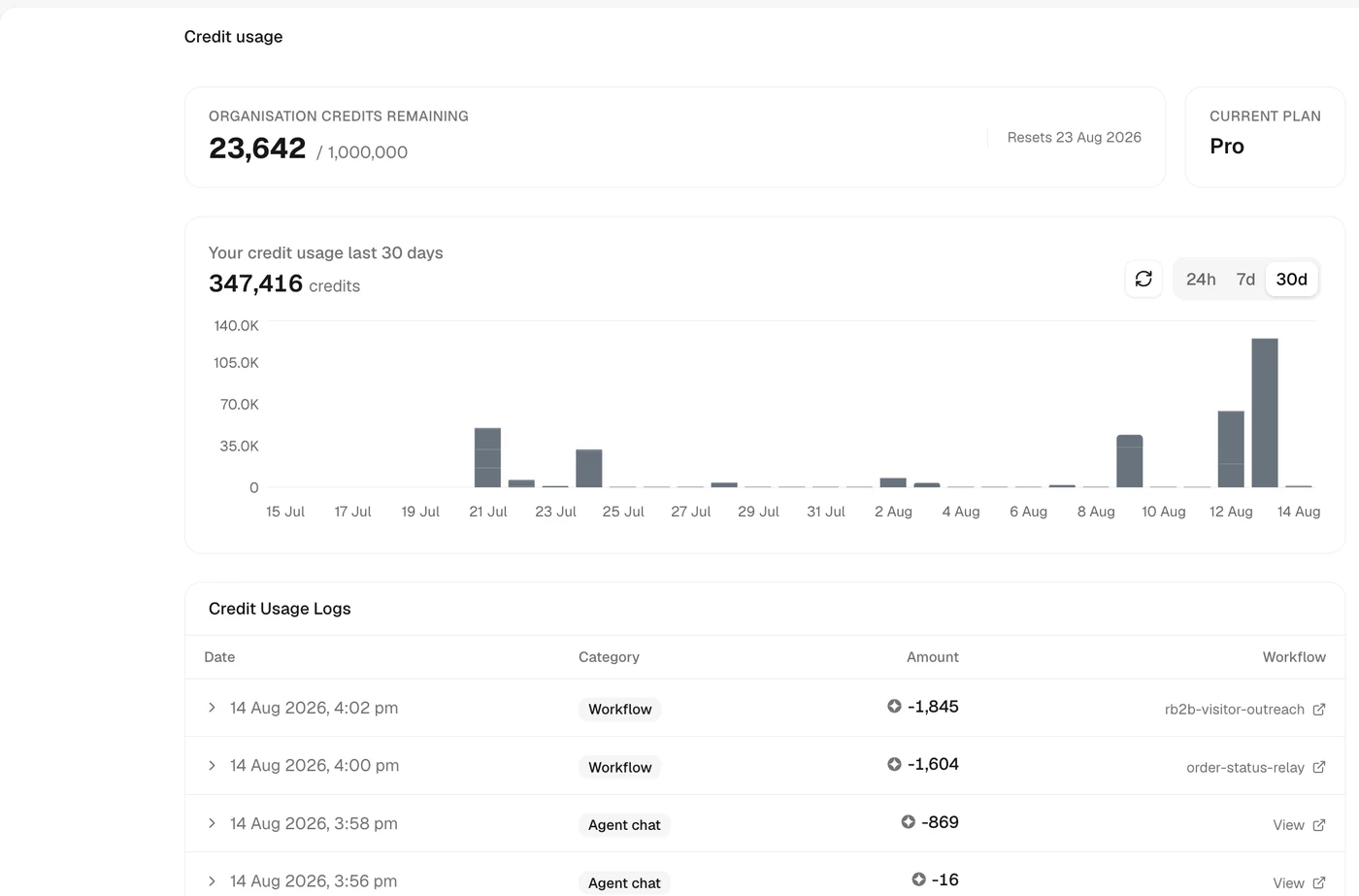
Trelium is more cost-effective at the company level because one agent can support an entire team. Our Starter plan begins at $500 per month and gives a business shared capacity to run roughly three to four meaningful agents across the organization, depending on workflow volume and complexity. Trelium does not charge based on how many employees benefit from those agents.
1
Shared capacity
One order-status agent can support an entire customer service team without buying a separate automation seat for every employee it helps.
2
Workflow visibility
Operations leaders can see which agents ran, how many credits they consumed, and which workflows are driving usage.
3
Company deployment
The unit of value is the business process, not the number of people who happen to touch the workflow.
4
Operational ROI
Savings are measured against hours returned, errors avoided, follow-ups completed, and cycle time reduced.
Which Is Easier for Non-Technical Teams to Set Up?
Trelium is designed so operations teams can describe a business process in plain English without first choosing connectors, plugins, schedules, API endpoints, or browser steps.
Cowork is flexible, but flexibility introduces concepts the user may need to understand: connectors, plugins, skills, permissions, schedules, local versus remote execution, and how the agent should interact with each system. Trelium is built to feel much simpler. Anyone on the team should be able to describe the work they want done and start setting up an agent without needing to understand the technical pieces underneath.
Setting up a Trelium agent takes very little time because the starting point is plain English. A user can say: when a customer asks for order status, check our order system, find the latest production and shipping information, prepare a response, and send delayed orders to the account manager. Trelium turns that into the workflow, identifies the integrations that are needed, and asks only for the business rules it cannot infer.
Easy agent setup
Trelium is designed so the person setting up the agent does not need to know which connector, plugin, schedule, API endpoint, or browser step should be used. They only need to know the business process: what comes in, what should be checked, what counts as an exception, who approves edge cases, and what should happen next.
That matters because the person best qualified to design the workflow is often not an engineer. In a promotional products company, the real expertise usually sits with the CSR who knows how customers ask for updates, the purchasing manager who knows which suppliers require follow-up, the accounting person who knows invoice variance rules, or the production lead who knows when artwork needs review. Trelium gives those people a way to explain the work directly instead of translating it into automation architecture first.
Trelium is also building template support specifically for the promotional products industry. That means teams will be able to start from pre-built agent templates for common workflows instead of a blank page. Those templates are not rigid. They are completely customizable, so a distributor, supplier, decorator, or print shop can adapt the workflow to its own systems, approval rules, customer communication style, and exception handling.
Templates and sharing
Claude Cowork does not come with promotional-products-specific agent templates. Trelium is built around reusable workflows: one person can build or customize an agent, share it with others in the organization at a click, and another teammate can edit that workflow for their own requirements.
AI assistant setup
Find tools
Search for the right connectors, plugins, permissions, and schedules.
Configure the task
Figure out how the assistant should reach each system and repeat the work.
Keep adjusting
Stay close to the workflow and update prompts when the process changes.
Trelium workflow setup
Describe the work
Tell Trelium what should happen in plain English.
Answer a few questions
Trelium fills in the setup by asking for rules, approvals, and systems.
Launch the agent
Run it, share it with the org, or customize it from a template.
How Do Claude Cowork and Trelium Handle Human Review and Approvals?
Trelium builds human approval gates, exception routing, and workflow history into the operational process so teams can decide exactly where a person should review or approve an action.
Trelium has a better review system because human approval is built into the workflow instead of being treated like a one-off chat confirmation. A company can decide which actions happen automatically, which exceptions go to finance, customer service, purchasing, or an account manager, and what information the reviewer needs before approving. Every approval, rejection, exception, and agent action becomes part of the workflow history, so the team can see what happened and why.
The goal is not to remove humans from the process. It is to stop requiring humans for the parts of the process where they add no value.
Claude Cowork vs. Trelium: Which Should You Choose?
Choose Claude Cowork for individual research, analysis, document work, and ad hoc multi-step tasks; choose Trelium when the goal is to run repeatable operational workflows across business systems and teams.
| Use case | Better fit | Reason |
|---|---|---|
| Researching a market, summarizing files, or drafting a report | Claude Cowork | The work is usually ad hoc, personal, and close to the user's context. |
| Matching supplier invoices to POs every week | Trelium | The work is recurring, rule-based, connected to accounting, and needs exception routing. |
| Checking order status and replying to customers | Trelium | The agent needs to read business systems, follow response rules, and escalate delayed orders. |
| Exploring whether AI can help a single employee | Claude Cowork | A personal assistant is a fast way to experiment with AI-powered task delegation. |
| Deploying AI agents across a distributor, supplier, decorator, or print shop | Trelium | The business needs integrations, event triggers, usage visibility, approval controls, and repeatable execution. |
Frequently Asked Questions
Is Claude Cowork or Trelium better for promotional products operations?
Claude Cowork is a strong fit for individual knowledge work and ad hoc multi-step tasks. Trelium is a better fit when a promotional products company needs persistent operational agents that run across email, ERP, order management, accounting, CRM, supplier portals, and internal systems.
Can Claude Cowork automate invoice matching?
Claude Cowork can help with invoice matching when the right tools and connectors are available. In the workflow we tested, the inbox monitoring step was shaped as a recurring scheduled check. Trelium treats invoice matching as a company workflow that can be triggered by incoming business events and governed by business rules.
What promotional products workflows can Trelium automate?
Trelium can automate operational workflows such as purchase order creation, supplier follow-up, invoice matching, order status updates, CRM updates, artwork coordination, customer communication, and exception routing for distributors, suppliers, decorators, and print shops.
Can non-technical operations teams use Trelium?
Yes. Trelium is designed for operations managers, customer service leaders, accounting teams, and other process owners who know the workflow but do not want to configure plugins, write code, or design automation logic from scratch. Users describe the business process in plain English, connect the relevant systems, and answer guided business-rule questions.
Claude Cowork and Trelium Solve Different Problems
Claude Cowork is a powerful product, and its capabilities will keep improving. Trelium also uses Anthropic models because they are excellent at reasoning, extraction, and tool use. The difference is the layer being built around those models.
Cowork is designed to make an individual dramatically more capable with AI. Trelium is designed to let a company deploy AI agents as part of its operating infrastructure.
For promotional products companies, that means connecting the systems they already use, triggering workflows when real business events happen, keeping execution deterministic where possible, maintaining clear human approval rules, sharing agents across the organization, understanding exact usage, and starting from workflows already shaped around distributors, suppliers, decorators, and print shops.
Cowork helps your employees work with AI. Trelium puts AI to work across your promotional products business.

Chirag Gupta
Member of GTM Staff
Get started
Ready to see Trelium in action?
Schedule a 30-minute conversation about the workflow you want Trelium to handle.
Book a Demo→