
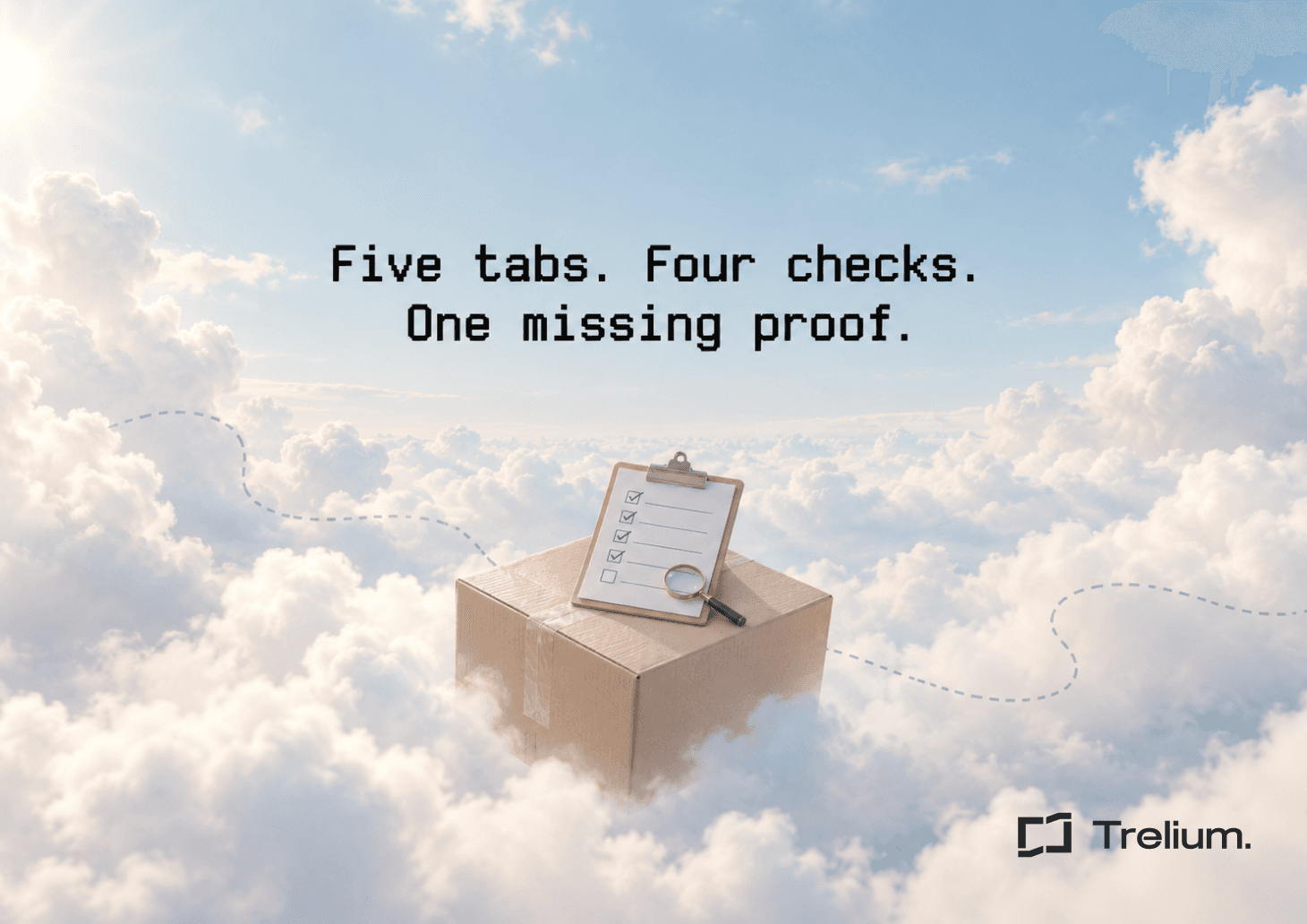
The sales order lands, and the scavenger hunt begins. Before anything can go to production, someone has to prove that the art, stock, decoration, pricing, and dates all check out. The clues are scattered across five different systems.
First stop, the email thread, to confirm the art was actually approved. And not just "looks good!!" on a version from three proofs ago.
Then the supplier site, to make sure the stock really exists and isn't just being optimistic.
Then the order record, to confirm the decoration method.
Then the quote, to make sure the pricing didn't quietly change somewhere between "sounds great" and "PO attached."
Then the calendar, the ship date, and the in-hands date, to answer the only question that really matters:
Can this order actually go to production?
The checklist might exist on paper. More often it lives in one coordinator's head, which is a great system right up until that coordinator goes on vacation.
What is a sales-order readiness review?
A sales-order readiness review is the last set of checks before an order is allowed into production. The goal is simple: make sure everything production needs is confirmed before anyone starts stitching, printing, or engraving.
The trouble is that "everything" rarely lives in one place.
A coordinator may have to dig through emails, the order-management system, supplier information, artwork records, quotes, and dates just to finish one review. Then do it again for the next order. And the next.
That's why the process has stayed manual for so long.
What actually needs to be checked before an SO is ready?
Most readiness reviews are a string of small checks rather than one big decision.
The exact list varies by distributor, but it usually includes:
- Art and approval status: Is the right artwork attached? Has the customer approved the proof, the actual final one?
- Stock: Is the product available in the right quantities, colors, and sizes?
- Decoration method: Is embroidery, screen print, transfer, engraving, or another method clearly specified?
- Pricing: Does the sales order still match the approved quote, including product, decoration, setup, and other charges?
- Dates: Do the production timeline, ship date, and customer in-hands date still add up?
None of these is hard on its own. You could explain any one of them to a new hire in thirty seconds.
The hard part is tracking down the answers to all of them, for every order, every day.
Why is sales-order readiness still so manual?
Because readiness is spread across systems.
The art approval is buried in an email thread. The order details live in the ERP. Stock has to be checked with a supplier. Pricing sits on the quote. Production timing depends on dates and wherever the order currently stands.
A normal rules-based workflow works well when everything is already structured and sitting in one place.
Readiness review is the opposite. It asks someone to collect context from several places, compare it, and notice what doesn't line up. It's less data entry and more detective work, minus the trench coat.
That's the job.
None of the checks is hard. Finding the answers to all of them is the whole job.
How can an AI agent handle the readiness checklist?
An AI agent can build the same readiness picture a coordinator puts together by hand.
Trelium agents can work across emails, documents, connected business systems, and browser-based tools, then compare what they find against the rules of the workflow.
So instead of a person juggling five tabs and a sticky note, the agent works through the checklist one item at a time.
Art approved? Confirm the approval status and the context behind it.
Stock available? Check the relevant inventory information.
Decoration method set? Confirm the order has the decoration details it needs.
Pricing correct? Compare the order against the source information the workflow is supposed to follow.
Dates workable? Gather the order and timing context so anything unusual can be reviewed.
The agent's job isn't to make every judgment call. It's to gather the evidence first, so the person making the call doesn't have to.
The Scavenger Hunt
- Open the inbox, the ERP, the supplier site, the quote, and the calendar
- Re-check every field on every order, just in case
- The checklist lives in one person's head
- Problems surface when production is already waiting
Agent-Assisted Review
- The agent gathers art, stock, decoration, pricing, and dates
- Clear orders pass the repeatable checks
- The checklist is written into the workflow
- Exceptions reach a person with the problem already identified
What would an automated readiness review look like?
It starts when an order reaches the point where it needs a readiness check.
The agent pulls the relevant information from the systems that distributor uses, then works through the list.
Art approval is present. Green check.
Stock is confirmed. Green check.
Decoration instructions are present. Green check.
Pricing matches the expected order information. Green check.
The dates line up with the workflow's requirements. Green check.
If everything checks out, there's not much reason for a coordinator to redo the same search by hand. That's five green checks nobody had to go hunting for.
The interesting part is what happens when one of them fails.
Exceptions are the work
The goal is not to remove people from the readiness decision. It is to stop making them manually verify every field when most of the order is already clear.
What happens when something is missing?
The order goes to a person with the problem already identified.
Maybe the proof is still waiting on approval, because the customer "will look at it tonight."
Maybe the requested quantity is bigger than the available stock.
Maybe the sales order has a decoration charge that doesn't match the quote.
Maybe the dates need someone to decide whether a rush is realistic or just wishful thinking.
Trelium's workflow model is built for this kind of exception handling. When information is ambiguous or a decision needs judgment, the agent can route the work to a person with the relevant context instead of forcing an answer.
The coordinator starts with the exception, not with the scavenger hunt.
Does the agent replace the sales coordinator?
No. The valuable part of a coordinator's job is deciding what to do when an order is unusual.
The repetitive part is gathering all the information needed before that decision can even happen.
That's the line.
An agent can assemble the readiness picture and run the repeatable checks.
A person still decides whether a shaky ship date is acceptable, whether a substitute product makes sense, or whether an unusual pricing change gets approved.
The judgment stays with your team. The tab-hopping doesn't have to.
Where should a distributor start?
Start with the readiness checklist your team already uses, even if it only exists in someone's head.
Write down every place someone looks before they're comfortable releasing an order: the inbox, the ERP, supplier information, artwork, the quote, the production schedule.
That list is the workflow. Pieces of it, like proof approval and stock checks, are already agents on their own.
Bring us your readiness checklist, including the unwritten parts, and we'll show you how Trelium would run it across the systems your team already uses. Book a workflow review.
Get started
Ready to see Trelium in action?
Schedule a 30-minute conversation about the workflow you want Trelium to handle.
Talk to a Human→