Chris manages customer service at a promo distributor. Three years ago the company paid a consultant to set up an RPA bot that copies orders from a spreadsheet into the order system. It works well, as long as the spreadsheet looks exactly the way it did when the bot was built. Last month a big client started sending POs as PDFs instead, and the bot can't read them. Chris's team is keying them by hand again, and someone suggested an AI agent. Chris's first question: "Isn't that just another bot?"
It is a fair question. Both run on your own computers if you want them to, both can click through your order system, and both are sold as a way to stop retyping. They work very differently, though, and that difference decides which one fits each job.
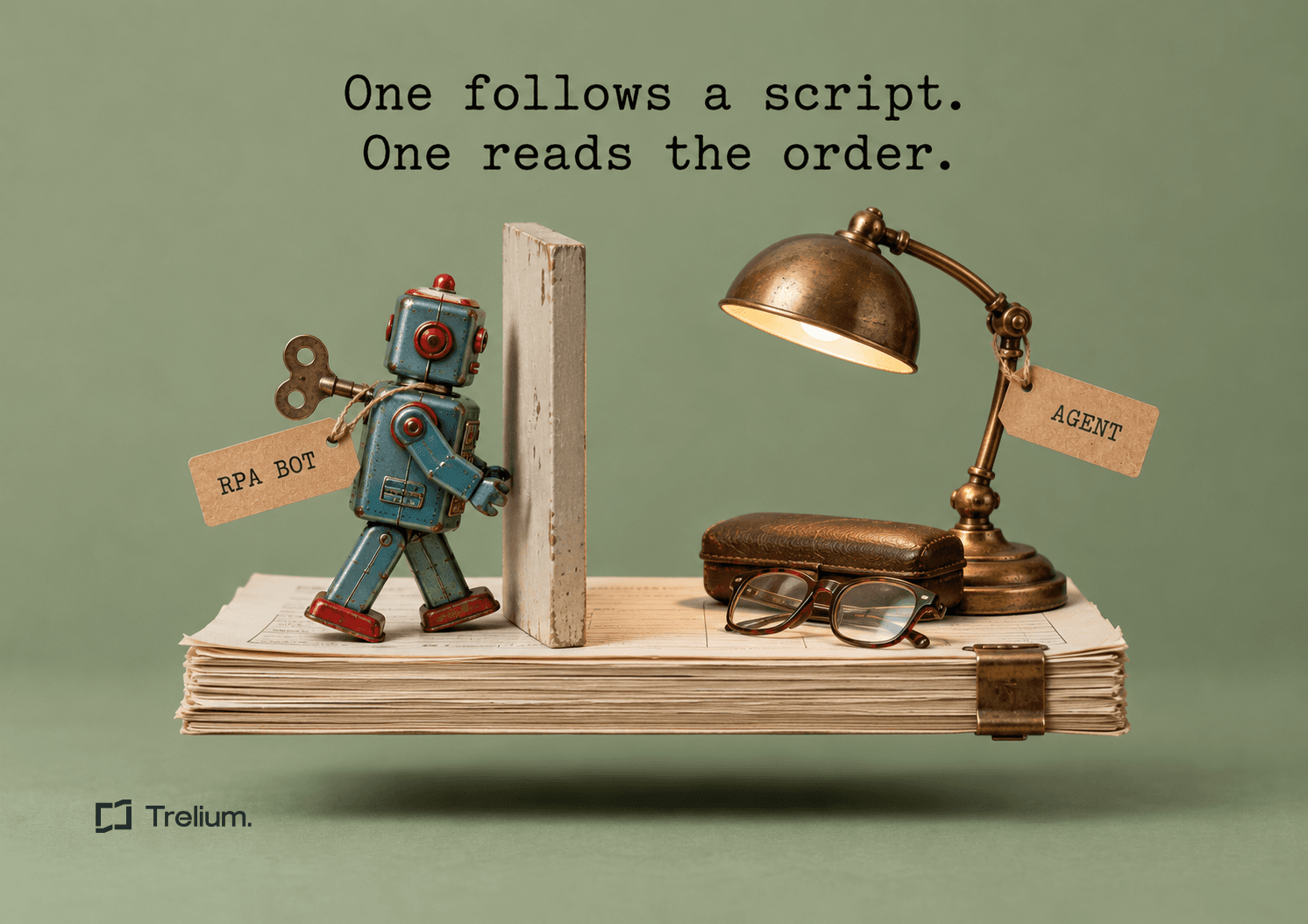
An RPA bot follows a fixed script of clicks and keystrokes, so it works well on tidy, predictable input and breaks when the input or the screen changes. An AI agent reads the input the way a person would, so it can handle a PDF PO, a typed email and a spreadsheet for the same job, and sends anything it isn't sure about to a person. Both can run on-premises.
What RPA actually is
RPA stands for robotic process automation. Despite the name, there is no robot. An RPA bot is a recorded set of steps: open this window, click this box, copy the value from cell B4, paste it into the "Qty" field, press Save. It does exactly those steps, very fast, as many times as you like.
That is useful when every order looks the same. It runs into trouble when:
- The input changes. A customer moves the PO number from the top of the page to the bottom, or sends a PDF instead of a spreadsheet.
- The screen changes. Your order system updates and a button moves. The bot clicks where the button used to be.
- Something is missing. A PO has no ship date. The bot either stops with an error or enters the order without it.
Many RPA tools now add AI features for reading documents, so the line between the two is getting blurrier. The question to ask any vendor is the same: what happens when the input doesn't look like what the bot was built for?
What an AI agent does differently
An AI agent is given a job and a set of rules instead of a script. For order entry, the job might read: "Read each PO in the orders inbox, find the customer, items, quantities, imprint details and in-hands date, create a draft order, and send it to a person if anything is missing or doesn't match the customer's pricing."
Because it reads the PO the way a person does, the agent can handle:
- A PDF from one customer, a spreadsheet from another and a plain email from a third.
- An item described as "navy polo, left chest logo" instead of a SKU.
- A PO that says "same as last time, but 200 more," by looking up the previous order.
The tradeoff is that an AI agent can misread something, just as a new hire can. That is why a good setup has the agent ask a person when it is unsure, and lets you require a person's approval before an order is saved.
Side by side
RPA bot
- Follows a recorded script of clicks.
- Needs input in the same format every time.
- Breaks when a screen or file layout changes.
- Doesn't know when something looks wrong.
- Usually rebuilt by a specialist when things change.
AI agent
- Works from a job description and rules.
- Reads PDFs, emails and spreadsheets for the same job.
- Copes with small changes in layout and wording.
- Can flag a missing date or an odd price to a person.
- Rules can be updated in plain language.
Both can run on your own servers
If your reason for considering either one is that your data can't leave the building, you don't have to give that up. RPA bots have long been installed on company computers. AI agents can be too. Trelium, for example, can be installed in your own data center or private cloud, so the agents work next to your order system.
There is one extra question for AI agents that RPA bots don't raise: the AI model. The agent may send the text of a PO to an AI model to understand it. Ask where that model runs and whether your team gets to approve it. Our post on running AI agents behind a firewall explains this in more detail.
When an RPA bot is still the right tool
RPA is not obsolete. Keep or choose a bot when:
- The input is always the same. For example, a nightly export from one system that is imported into another, in a format that never changes.
- There is no reading or judgment involved. Copying a tracking number from one field to another is a script, not a decision.
- It already works and nobody has to babysit it. Replacing a reliable bot only to say you use AI is wasted effort.
When an AI agent is the better fit
Choose an AI agent when:
- Orders arrive in many formats. POs by email, PDF, spreadsheet and the occasional photo of a printout.
- Someone on your team spends time deciding things. Is this the right customer? Is the price on this PO the one we quoted? Is the in-hands date realistic?
- Your bot breaks every time a customer or a screen changes. If you keep paying someone to fix the script, the job has too much variety for a script.
A simple way to decide, job by job
Don't decide for the whole company at once. Take one job at a time and ask:
- Does the input look the same every time? If yes, a bot can do it. If no, lean toward an agent.
- Does the job need judgment? If someone reads, compares or decides, lean toward an agent.
- How often does it break today? Frequent breaks mean the job has more variety than a script can handle.
- Does the data have to stay on your servers? If yes, make sure whichever option you pick can be installed on-premises, including the AI model for an agent.
What Chris did
Chris kept the RPA bot for the one client whose spreadsheet never changes. The PDF POs, plus the email orders the team had always keyed by hand, went to an AI agent that creates draft orders. A person on Chris's team approves each draft for the first few weeks, then only the ones the agent flags.
FAQ
Is an AI agent just a smarter RPA bot?
Not quite. An RPA bot repeats recorded steps. An AI agent works from a description of the job and reads each document to decide what to do. Some RPA tools now include AI features, so ask any vendor how it handles input that doesn't match what it was built for.
Can an AI agent use our order system if it has no way for software to connect?
Often, yes. Like an RPA bot, an agent can work through the system's screens. With Trelium, a browser agent does this through the system's web interface. Where a system does offer a direct connection, that is usually more reliable, so use it when you can.
Do we have to throw away our RPA bots?
No. Keep the ones that work on predictable jobs. Use AI agents for the jobs where the bots keep breaking or where your team still reads and decides by hand.
Which is cheaper?
It depends on the job. A bot can be cheap to run and expensive to keep fixing. An agent can cost more per task, but it usually copes with new formats without someone rebuilding it. Compare the total time your team spends, including fixing and checking, not just the license.

Anindo Neel Dutta
Member of GTM Staff
Get started
Ready to see Trelium in action?
Schedule a 30-minute conversation about the workflow you want Trelium to handle.
Book a Demo→