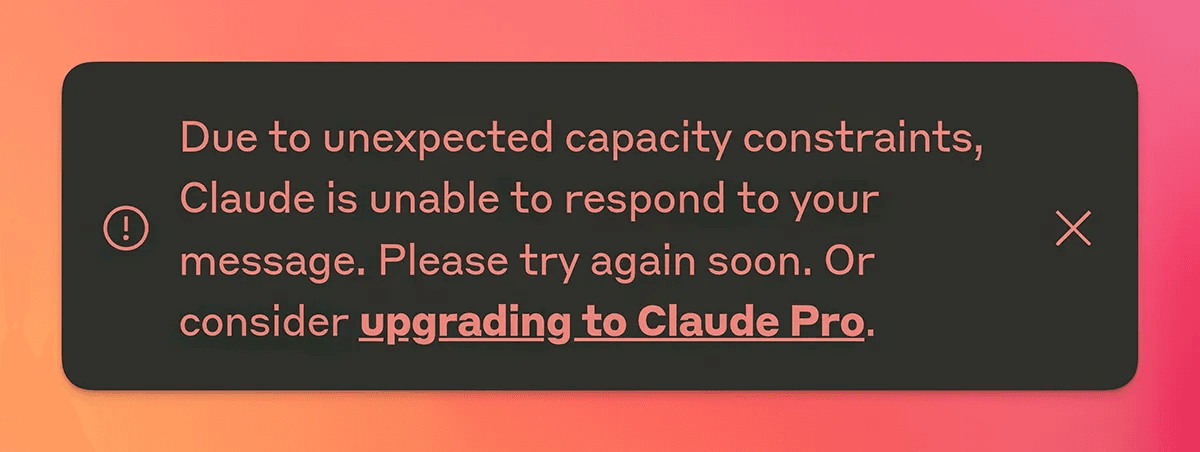
Every few months, ChatGPT or Claude tightens what a paying subscriber can actually do. Weekly caps, session limits, quieter model swaps once you've used enough of the good one. Read those changes as a signal, not a glitch.
None of this is a coincidence. It's what happens when a product priced to win as many users as possible runs into the real cost of running it. And if your business has started routing actual work through one of these tools, that math is worth understanding before it changes the rules on you.
Inference Isn't Free, and It Never Was
Every message you send to a large language model runs on real compute. Someone pays for the GPU time whether the answer is a haiku or a full data extraction from a ten-page PDF. A flat $20, or even $200, monthly subscription was never a reflection of what heavy usage costs to serve. It was an acquisition price, set to get as many people as possible hooked on the product while the category was still being decided.
That's a reasonable strategy for growth. It's a risky foundation for a business to build critical workflows on top of.
Rate Limits Are the Real Financial Disclosure
You don't ration something that's cheap to give away. When a provider introduces a weekly cap on top of a monthly subscription, quietly routes you to a smaller model once you've used enough of the flagship one, or throttles the accounts that use the product the most, that isn't a UX decision. It's the cost structure showing through the pricing page.
Watch how these limits move over time and a pattern shows up: they tighten, rarely loosen, and land hardest on the accounts using the product the way a business would, every day, at volume, for real work. That's not the group a subsidized pricing model was built to support.
What Happens When a General-Purpose Chat Subscription Becomes Your Business's Dependency
A chat subscription built for individual, casual use is a very different thing once your team starts routing customer replies, order data, quotes, or reporting through it every day. At that point, it's no longer a convenience. It's infrastructure your business depends on, except it comes with none of the guarantees infrastructure is supposed to have.
There's no SLA on a personal or team chat plan. No advance notice before a usage policy changes. No accountability if a rate limit hits your team mid-week and the workflow it was tied to just stops. If the model gets quietly swapped for a cheaper one under load, you may not even know your output quality dropped until a customer notices first.
Picture an employee who works hard all morning and then, with no warning, walks away from their desk for the rest of the day because they hit an invisible quota on how much they're allowed to help you. That's what a session limit does to an agent mid-workflow. The harder it works for you, the sooner it hits the wall, and the wall shows up in the middle of the task, not at a convenient stopping point. You wouldn't run a team that way. You shouldn't run your automation that way either.
A consumer chat subscription was never priced for what a business does with it every day.
The Math That Should Worry You
Here's the shape of the problem. Your subscription price is flat. Your usage isn't. As a workflow proves useful, more people on your team use it, more often, on longer and more complex tasks. The cost of serving that usage keeps climbing. The price you pay does not, until the provider decides it has to.
Something has to close that gap. Either the provider absorbs a growing loss on its heaviest users indefinitely, or it protects its margins by capping, throttling, or downgrading the accounts using it the most, which happen to be the businesses depending on it most. The last two years of usage policy changes across ChatGPT and Claude show which choice keeps getting made.
General-Purpose Chat Subscription
- Priced for individual, casual use
- Flat fee regardless of how central it becomes to your ops
- Usage caps and model swaps set unilaterally, without notice
- No SLA or accountability for the workflow built on top of it
- Pricing built to win market share, not to reflect cost to serve
Trelium
- Built around your workflow, not a general chat window
- Priced for the automation actually running your operations
- Efficiency gains passed back to you as workflows mature
- Deterministic execution used instead of paying for an LLM call on every repeatable step
- A partner accountable for the workflow, not just access to a model
What Passing On Savings Actually Looks Like
Not every step of a business workflow needs a frontier model making a fresh judgment call. Trelium reserves the model for the parts of a workflow that genuinely need reasoning, and uses deterministic code for the repeatable parts, the same order-entry pattern, the same field mapping, the same status update, that don't need to be re-decided from scratch every time. That's cheaper to run, and it's built to stay cheaper as usage grows, not more restricted.
That's the difference between a product priced to win your signup and a product priced to run your business.
The Takeaway
If a task is core to how your business runs, it deserves infrastructure built for that job and priced to last, not a subsidized subscription that can change the rules the moment you depend on it. Before you build another critical workflow on top of a general-purpose chat plan, it's worth asking what happens the day its usage limits tighten again.
Bring us one workflow your team runs through ChatGPT or Claude today and we'll show you what it looks like running on infrastructure built for it. Book a workflow review.

Ritanshu Dokania
Co-Founder
Get started
Ready to see Trelium in action?
Schedule a 30-minute conversation about the workflow you want Trelium to handle.
Book a Demo→